The Cost of Solidarity in Bearing Witness to the Palestinian Struggle
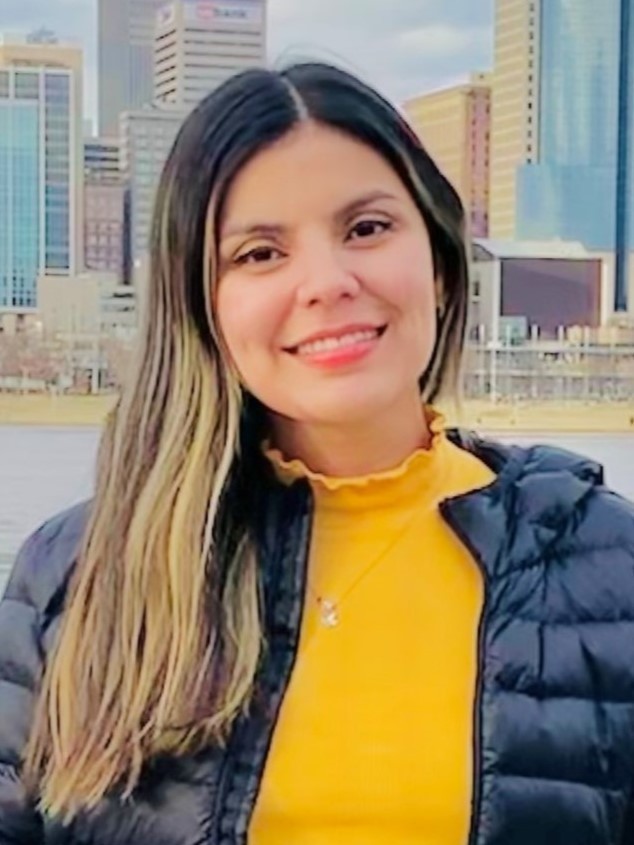
I first began learning about Palestine in 2012, when I was in grade 10. Like many people, I was taught to understand what was happening as a “conflict”, which I later learned belittles the experiences of Palestinians. As I read more, I felt shocked by what I was learning. When I tried to speak out, through social media, which was the only way I knew how, I was met with criticism and shame. That moment taught me an early lesson about the cost of solidarity, a lesson that remains true today for many who speak out. Standing with the oppressed often comes with judgment, discomfort, and social cost. This is not a reason to stay silent; it is part of what solidarity requires.
Years later, when the opportunity came to travel to Palestine and attend the Kairos conference, I chose to go knowing that criticism could potentially follow. This time, I knew it was something I could carry.
And yet, even in this environment, I encountered hope.
In Palestine, I listened. I learned. And now I share stories of sorrow and hope, stories that call us into solidarity.
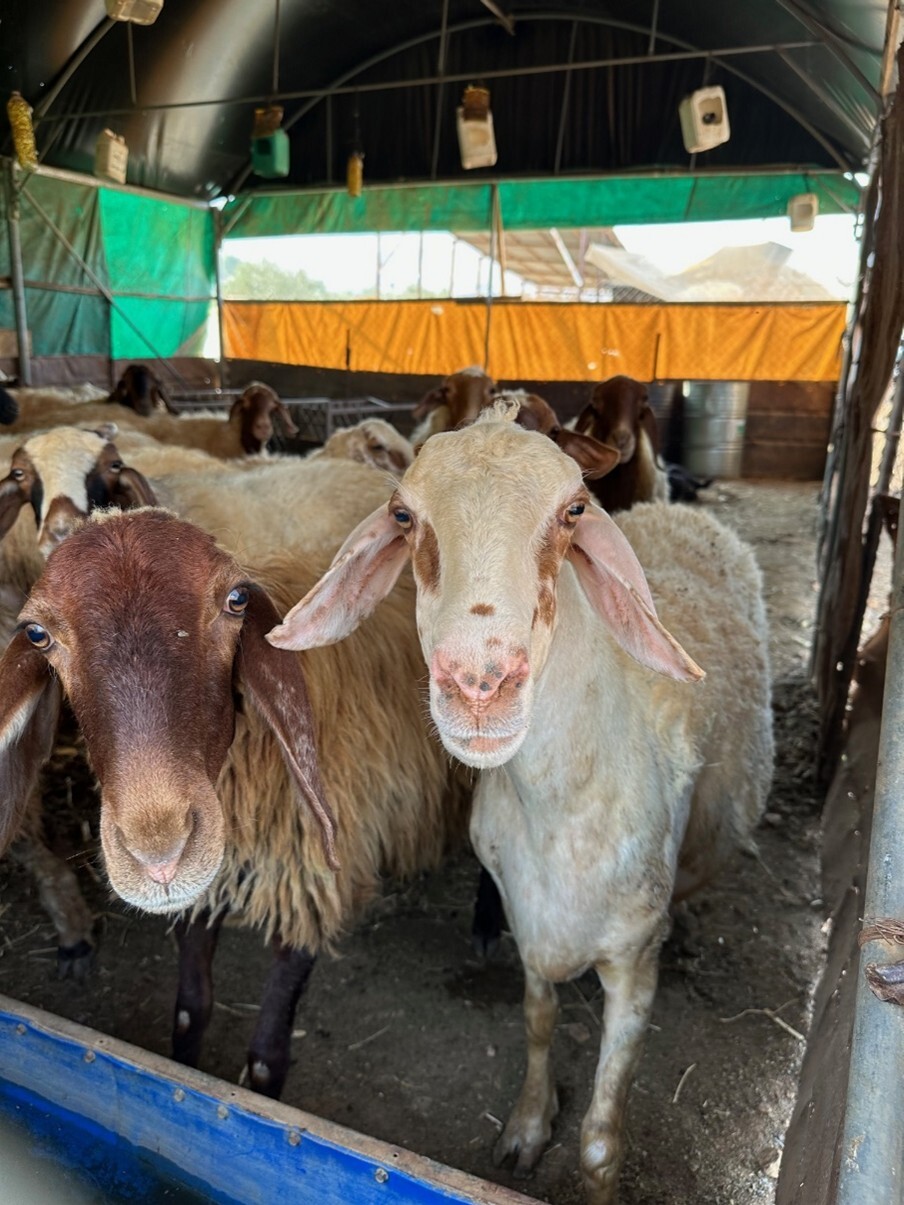
Palestinian-owned goat and sheet farm
I visited a Palestinian farmer in a remote and difficult-to-reach location, where the roads to enter the community had been ripped out by the Israeli military. Palestinian community members claimed that those acts are done to make life more difficult and slower for them. As I arrived at the farm, 5–8 military jets flew overhead. “This is a military aircraft training zone,” a group leader explained. All these experiences, I was told, are ordinary life for Palestinians: military exercises above their homes, and communities disrupted by raids and demolitions. And yet, even in this environment, I encountered hope. A farmer was proud that she could send one of her three daughters to university by selling cheese and milk from the goats she owned, but only within the West Bank, since movement and trade are heavily restricted for Palestinians.
I also spent time listening to teenagers who had been injured in encounters with the Israeli military. I had heard many stories of children and teenagers being injured and hurt, but seeing and meeting them in person was deeply unsettling and heartbreaking. Each of them lived with a lasting physical disability.
Hearing these stories in the Holy Land was extremely heartbreaking.
One story remains especially heavy. A boy I met mentioned that he was fourteen years old when he was shot in the back of the neck by the Israeli military. The bullet exited through his cheekbone, permanently damaging his vision and facial structure. He survived, but his life has been changed forever. He explained that after being rushed to the hospital, the military followed him there and arrested him, claiming it was a security issue. He was put in jail instantly, without a trial, for eight months and was denied proper medical treatment despite having been just shot. He was unable to speak about his experience in jail, but from the reports I learned about the treatment Palestinians endure while detained, words feel insufficient. He was fourteen, only two years younger than the version of me in grade 10 who first learned about Palestine.
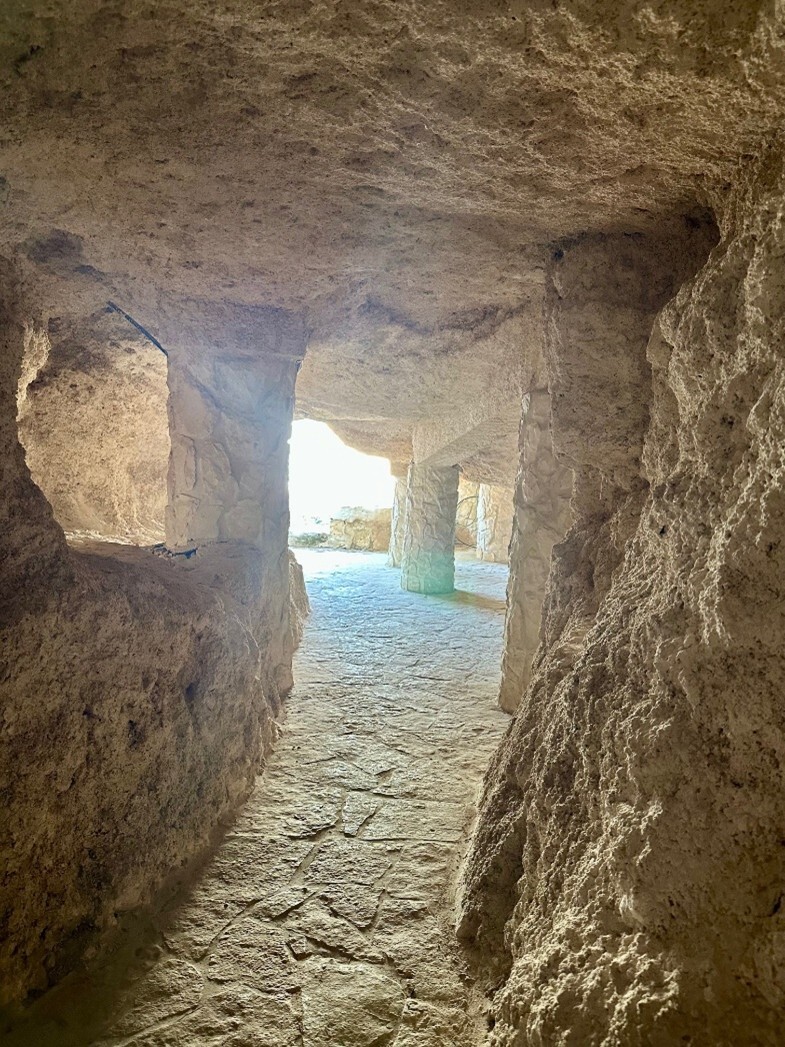
A cave where injured Palestinian youth receive mental health support
As we left the community, we encountered a violent roadblock of a car damaged with various bullets, and it was set in place for those entering and leaving. I thought about the youth we had spoken with when we left. Every time they pass through, that car stationed there serves as a reminder of the violence surrounding them. There is no escaping it; it is everywhere, even within their bodies.
Hearing these stories in the Holy Land was extremely heartbreaking. Yet, like the birth of Jesus under occupation, I encountered a quiet and unexpected form of hope.
As I was about to enter a taxi, a young Israeli man asked if we could share the ride to the bus station; I agreed. Later, as I boarded a five-hour bus ride back to Jerusalem, we found ourselves seated beside one another again. During that journey, I learned that he had just been released from jail for refusing to serve in the Israeli military. He did not stand with Israel's military actions or ideologies, and because that refusal is considered a crime in Israel, he was imprisoned. At one point, he said, “You can’t be scared to be friends with a Palestinian. Those barriers and fears need to end. There is a way forward.” In him, I saw a glimpse of hope, a young Israeli man consciously rejecting the oppression and violence carried out towards Palestinians for years.
Our call as Anabaptist Mennonites is to strive to be a people who live out nonviolence with courage, who refuse silence, who do not avoid hard truth even when it is uncomfortable, and who are willing to challenge injustice.
Written by Christian Palestinians, the Kairos Palestine 2 document speaks about what Palestinians describe as decades of living under systems of occupation, apartheid, ethnic cleansing, settler colonialism, and now genocide. Within the document, the authors state that Israel commits these crimes, invoking the events of October 7, 2023, claiming that its actions are an act of self-defence, forgetting that the Hamas attack of that day was itself born out of decades of injustice since the Nakba of 1948, and more than sixteen years of an immoral, suffocating blockade on Gaza. Jewish organizations such as Rabbis for Human Rights and Breaking the Silence also acknowledge this perspective.
Providing this context is not intended to justify the killing or capture of civilians. Violence against Jewish communities is wrong and stands in direct opposition to my values and those of the Kairos authors. At the same time, listening to Palestinian families describe years of restricted movement, displacement, dehumanization, and daily humiliations helped me understand how some forms of resistance have turned desperate and violent. This is not a justification; it reflects what I heard and witnessed. Consequently, meeting the young Israeli man was especially meaningful because he serves as a reminder that even within these systems of injustice, people can choose a different path. There are creative and nonviolent ways to stand with the oppressed, to speak up, and to act justly. But how?
Kairos Palestine 2 calls Christians around the world to move beyond sympathy and towards truth-telling and courageous action to end Israel’s occupation and to pursue peace grounded in equality, international law and non-violent resistance. The authors urge churches, governments, institutions, and individuals to name what is happening for what Palestinians themselves describe it as: apartheid, ethnic cleansing and genocide, not simply “conflict” since that language erases daily experiences. The document also urges institutions, churches and individuals to take concrete action through sanctions, boycotts, and arms embargoes, and to practice what they describe as costly solidarity by centring Palestinian voices and speaking up in churches and within personal relationships, even when doing so leads to judgment and criticism.
Therefore, our call as Anabaptist Mennonites is to continue listening to Palestinian voices as we strive to be a people who live out nonviolence with courage, who refuse silence, who do not avoid hard truth even when it is uncomfortable, and who are willing to challenge injustice.
Another boy added that once Palestinians are arrested, the Israeli military has access to all their personal information, including their names, home addresses, and phone numbers. He added that this enables constant monitoring and intimidation by the military. One teenager described receiving a phone call from an Israeli military officer threatening him by saying, “We do not want to kill you; we just want to hurt you”. They explained how they are being targeted at a young age by the Israeli military to teach them not to resist.
For further information, reflection, and communal discernment, engage with the study guide, A Moment of Truth: Faith in a Time of Genocide, drawn from the Kairos Palestine 2 document, with your congregation, friends, and broader community.
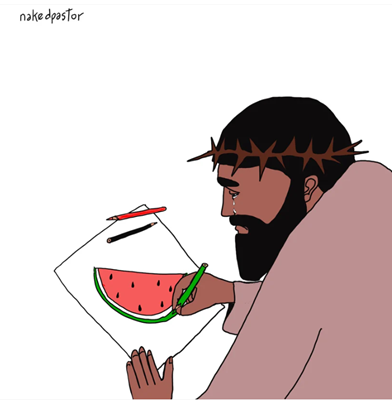
Jesus in solidarity and sympathy with the Palestinian people
Study guide: A Moment of Truth: Faith in a Time of Genocide.
Kairos Palestine II (KP2) is a confessional document written by the Palestinian Christian Ecumenical Initiative and released on November 14, 2025. This study guide is adaptable for use in a variety of
settings.
This resource is endorsed by the constituency-based MCEC Palestine Israel Network Working Group serves the MCEC constituency by promoting awareness and education on specific issues and topics. The information and links are those of the Working Group and do not necessarily represent MCEC as a whole.